
A seed stage engineering team ships about 3 new features a month. If your customers don’t notice, it’s a waste of engineering resources.
Today’s roadmap seriously outpaces the GTM team’s ability to execute. A recent post from Battery Ventures reported that some product leaders hear that customers want to slow down new features because the UI changes too often. Which points to the importance of adoption. End-users must have time to navigate new updates, let alone start to use them.
Thanks for reading! Subscribe for free to receive new posts and support my work.
Slack community comms or a changelog isn’t adequate, especially when you’re seeking new customers that aren’t on Slack yet. People on the GTM or customer-facing side of the house must now be lock-step with product and engineering, from the very moment it’s being built. I’d argue even earlier, at the idea stage.
Timelines have significantly changed which impacts roles and jobs to be done.
The bottleneck moved from building to launching
A recent CPO insights report based on 1,500 product leader inputs validate that bottlenecks have now shifted to GTM execution and customer adoption.
Because features can get copied in weeks, builders are now hamster wheeling to stay ahead of the market. The bigger question for the product becomes will that feature actually impact customer adoption and will it help achieve revenue targets. Is the company staying true to its core mission or is it starting to be a look-alike in a crowded market
It’s extremely hard for GTM teams to communicate value if the feature roadmap doesn’t quite add up to the core company value that’s already being communicated. Churning out new features faster isn’t always the answer.
The only thing that matters is that your buyer fully understands the direction you’re going so they keep investing, and hopefully expand.
What product marketing actually is now
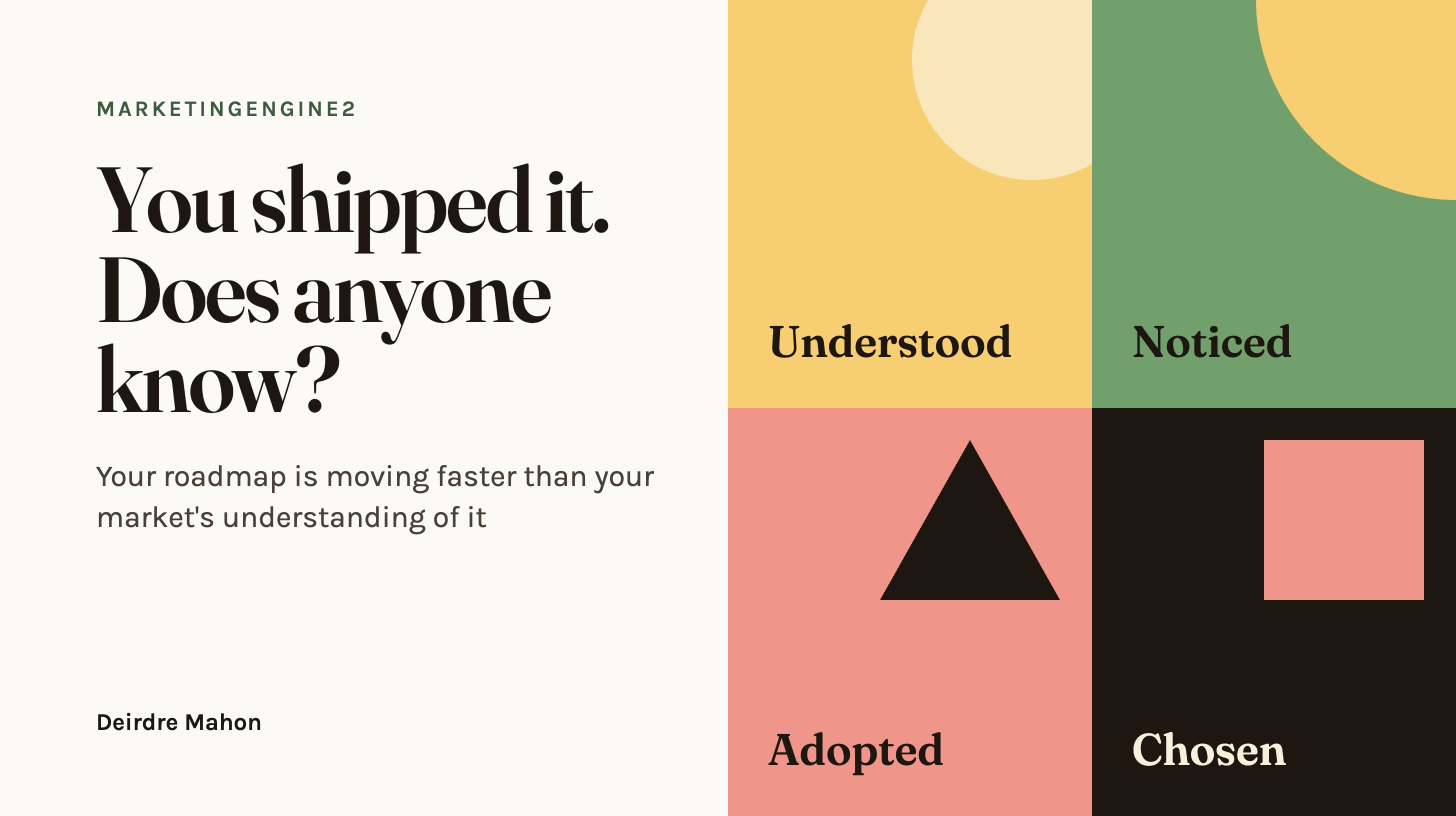
Product marketing has always been the glue between product and GTM teams. Regardless of the job title of who’s doing it, the role starts with message and position creation, defining clear value compared to the competition. Boiled down, the job is to make the product understood, noticed, adopted and chosen, for the long-term.
In simple terms that translates to these workloads or jobs:
Understood - “Why us” in one sentence
Noticed - launches and ongoing updates
Adopted - education and how-to’s
Chosen - sales enablement, competitive take-downs.
The basics haven’t changed much. What has significantly changed are the tools, the speed and the constant juggling of an even wider range of tasks.
PM and PMM are now often one seat
In early stage startups, the founder often takes on the role of deciding product direction. That quickly evolves to product marketing work, especially during customer acquisition which as we know, never ends. AI capabilities have made such multi-tasking all the more possible though context-switching gets harder as you grow.
Many product managers have historically been inward facing with a focus on what to build and how. They’re usually good at describing what exactly the product does. However buyers need to know why it matters to them and how to use it in the context of their job and other tools.
These are two different muscles that are now evolving into one role, or one seat. The PM-PMM needs to be both inward facing and outward customer-facing. They also have to translate what it means for sales, partners and customer success. They essentially become a master translator and a pivotal role inside any product-led company that ships fast.
As the company grows and scale becomes a challenge, more often the PMM reports into product management. This keeps those functions even more tightly inter-connected.
I believe this collapsing of roles or tightening is good as long as someone deliberately owns the market side. Otherwise it silently disappears.
Product updates are a growth channel, not housekeeping
Releasing new product updates is a very good thing, especially if they’ve been requested by your end-users. And of course mapped to the overall mission which we already talked about.
The truth is that each release is a perfect reason to re-engage customers, prospects and partners. Don’t waste it. Ask for feedback, ask for any further input and perhaps an endorsement or a referral. There’s nothing better than happy users willing to brag.
Pick your frequency
PM and GTM should pick a rhythm: monthly “what’s new” email, a public changelog, in-app announcements, and perhaps a quarterly big launch moment. Don’t forget that repeating yourself at the end of each month or each quarter is a good thing. Also communicate on multiple channels. Many people don’t pay attention and need to be told multiple times. Everyone on the entire team should proudly communicate. Yes, on socials too.
Lead with differentiating features. Bug-fixes don’t need the spotlight. Tie each update back to the reason so your story compounds.
Education and adoption: the work after the sale (and sometimes before)
Product usage tools like Amplitude tell you how well adopted a certain feature is. Any of those unused features become churn and lost expansion.
Users are incredibly busy working on their own to-do lists so you need ongoing education programs. At Catch&Release, we conducted a masterclass program which was tremendously helpful bringing full teams together for a half day session, recorded for remote teams to watch later.
A library of how-to videos on YouTube or your own internal channels work like a dream. Easy to digest will become the go-to learning especially if you stay consistent with this and educate users where to look.
Make sure it’s AEO-friendly and easy to find. Don’t treat all users the same. As we know some users will go the extra mile to figure something out but many won’t have the patience or take the time to self-learn.
This type of content is queen especially when trying to attract new customers. I advocate to create educational, how-to’s vs demo-ware as it will stand the test of time and satisfies both goals.
Spot the signals you need product marketing now
You may think it’s too early. Use this checklist:
You’re shipping faster than you can communicate to the market
Customers ask for features you already shipped
Your sales pitch and website describe the product differently
Trial users or POV prospects stall when trying to use the product
You lose deals to competitors with a weaker product but a better story.
The human side: judgment AI can’t supply
Yes your AI assistant can release docs and product notes instantly. However, verbose lists can’t decide which is the most important or critical for a particular customer.
If you’re in a market category that is busy and noisy you’ll need real creativity to stand out, especially if the incumbent is large with deep pockets.
For early marketers operating as a generalist inside a young startup today, I advise you to take on the role of product marketing as it will become great training for your future.
When your customers don’t know what your shipping and why, you will go unnoticed. Without adoption, no-one cares. Instead you’ll create a frustrated and burnt out engineering team scratching their heads about why they’re not winning.
What did you ship last month that your users still don’t know about?
What would you do differently next time? Remember, you need the majority to notice, not 2% of your target.
Thanks for reading! Subscribe for free to receive new posts and support my work.