
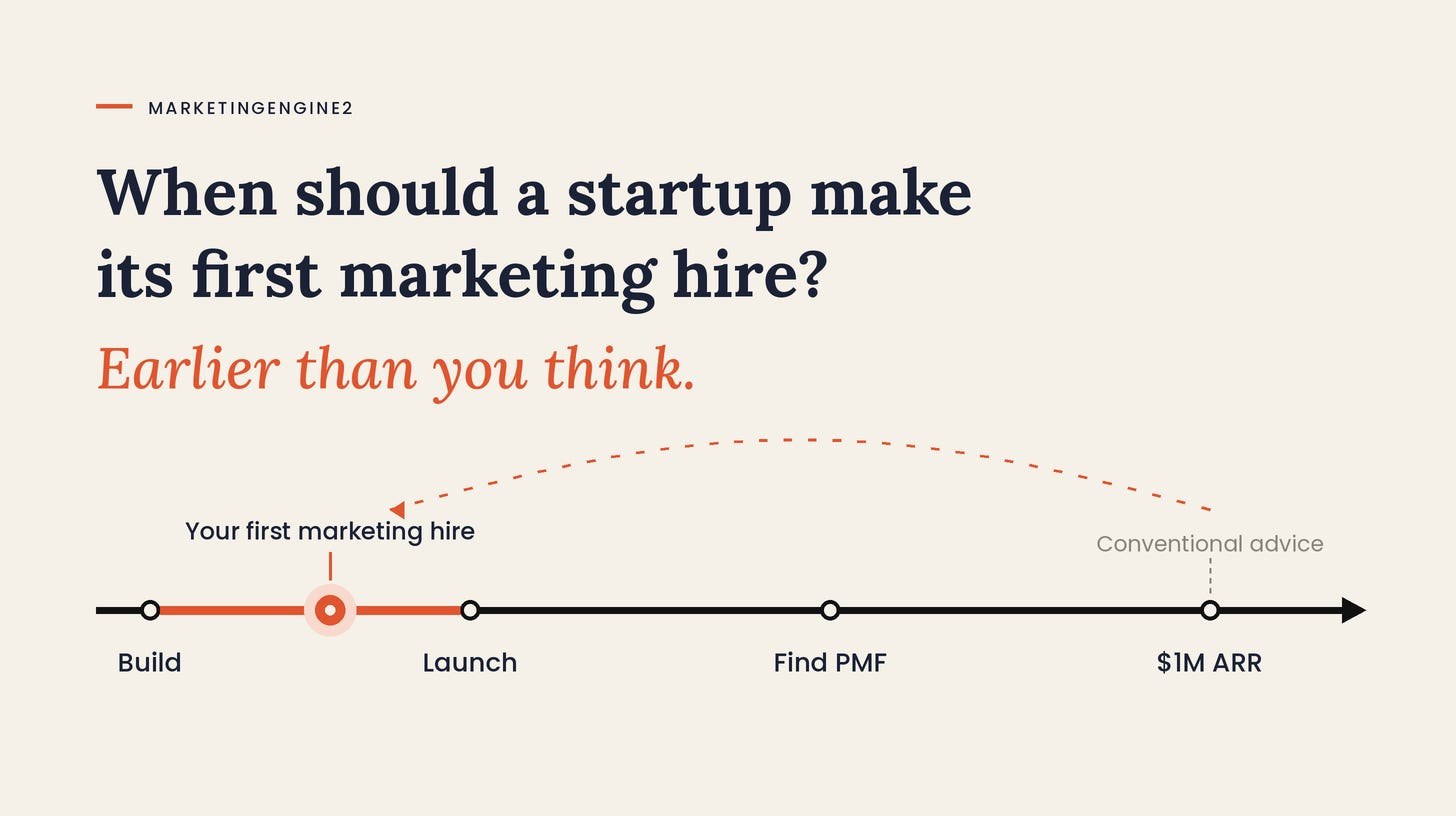
The standard advice most founders get: wait for product-market fit or $1M ARR, and meantime, do it yourself. That worked when building was the hard part. It no longer is.
This assumes the founder can run all marketing and GTM on top of building, fundraising and meeting customers. There aren’t enough hours in the day, even when AI is your BFF.
Thanks for reading! Subscribe for free to receive new posts and support my work.
A founder recently told me, “I have no bandwidth or desire to create content, let alone post on social three times a week.” Fair, but that’s literally what it takes to get attention. My response: “How will the market know who you are and what you do?” And the market doesn’t like AI slop, so you can’t ChatGPT your way through this.
What’s changed in the last three years?
A small team now ships in days or weeks what used to take quarters. Every category is crowded, features get copied faster than ever, and durable product advantages are much harder to build.
What’s rare is a clear point of view, backed by a product that lives up to it’s bold claims. Trust is sadly scarce, and getting a busy buyer to care is tough. That’s the job of marketing.
When anyone can build a product, the ones with a fighting chance are the ones that know how to reach buyers and are well understood.
Engagement takes time. Knowing your buyer and their channels gets you reach, not engagement. So when you interrupt a potential buyer, make it useful and worth their time. You won’t get another swing at the bat, so don’t f*** it up.
Don’t wait for the coveted PMF
Product-market fit is when your target buyer responds, gives useful feedback and pays, repeatedly. It never means you’re done, but at least heading the right direction.
Getting there takes time. Founders I’ve spoken with recently average three pivots to find PMF, and one pivot can take six months. If it takes 7–12 touches to engage a buyer, that’s about 7–12 weeks of time transpired to get a response.
Tune your message and position on the way to PMF
Until you’re having real conversations with prospects, you won’t know if your message resonates, or whether a pivot is needed.
Early at Honeycomb.io, we targeted the head of engineering as our buyer. It turned out we needed a bottoms-up approach first: IC engineers had to get hands-on so they could say “yes” when the VP asked if it worked. They fell in love with the product because it pinpointed which part of their code caused an issue. The reality is that a VP isn’t triaging during an outage; they are.
Busy founders often hear only the last customer call, not what prospects say in aggregate. They spend a year chasing customers with a muddy story, then hire a marketer when they think they just need to scale.
So what does “earlier” mean, and who do you hire?
You don’t need a big full-time team. For many, that means fractional or advisory help: someone who can think at a high level, build a plan and get hands-on with execution.
The early marketer should be a Jack and Jill of all trades: a business thinker first, with no prima donna notions. A builder who can write, ship and measure, and who uses AI to do the work of three people, rather than a strategist who needs a team under them.
Four signals you need to hire early:
- Your product is ready and you want to officially go to market
- You can’t explain why you’re different in one sentence
- You keep rewriting your why and your value
- You’re the bottleneck on every piece of content
The human side of the job
Sure, you can build agents to execute tasks. But humans bring judgment, taste and empathy for buyers. Early on, you’re educating and informing but also building trust. You can’t do that with a bot, and cold email is a terrible way to earn it.
Younger marketers will want to lean into GTM engineering roles, but the tendency is to default to Claude (pick your fave AI tool), often without the knowledge, shortcuts and domain expertise that come with experience.
Still waiting for traction?
Founders often hire salespeople as soon as the product is stable, expecting them to do outbound, content, events and closing. Most have no appetite for that. Their first ask: “Where are my warm leads?”
Sales hires are costly and the wrong place to start learning your market. Marketing is always in the long game; sales is the short game. Why start the short game before the long one? The timing is backwards.
If you’re a founder who has built something powerful, where are you stuck today? What do you need help with now?
Next post: what a marketing generalist should do in the first 90 days.
Thanks for reading! Subscribe for free to receive new posts and support my work.