
You just hired a founding marketer. Around week three, you ask: “Where are my leads?”
The honest answer is that they’re setting up systems, standing up channels, creating content, researching the market and sitting in on customer calls. That’s not stalling. That’s the job.
Thanks for reading! Subscribe for free to receive new posts and support my work.
Task one is always to listen: learn what’s working, or form a strong hypothesis about what should. In parallel, build the minimum viable engine so you can run quick experiments before pouring on gas ($). Every outbound touch needs a story, clear messaging, quality assets, a channel and a way to measure and adjust. Skip any of those and you’re lighting money on fire.
Set expectations early, or regret it later
You hired a generalist for a reason. Someone who only automates and stands up tools won’t know how to message, and if they do, they probably can’t create quality content fast. Marketing is relentless context switching, and keeping every ball in the air is hard unless you’ve been there and done it.
With limited budget and the clock ticking, agree on one target persona and a short list of channels. Nail the message, CTA, supporting content and landing pages. Only then are you ready to go. Document everything somewhere visible to all. It’s like baking a cake: skip the key ingredients and it tastes like cardboard, and you’ve burned precious time baking it.
How long until you see results?
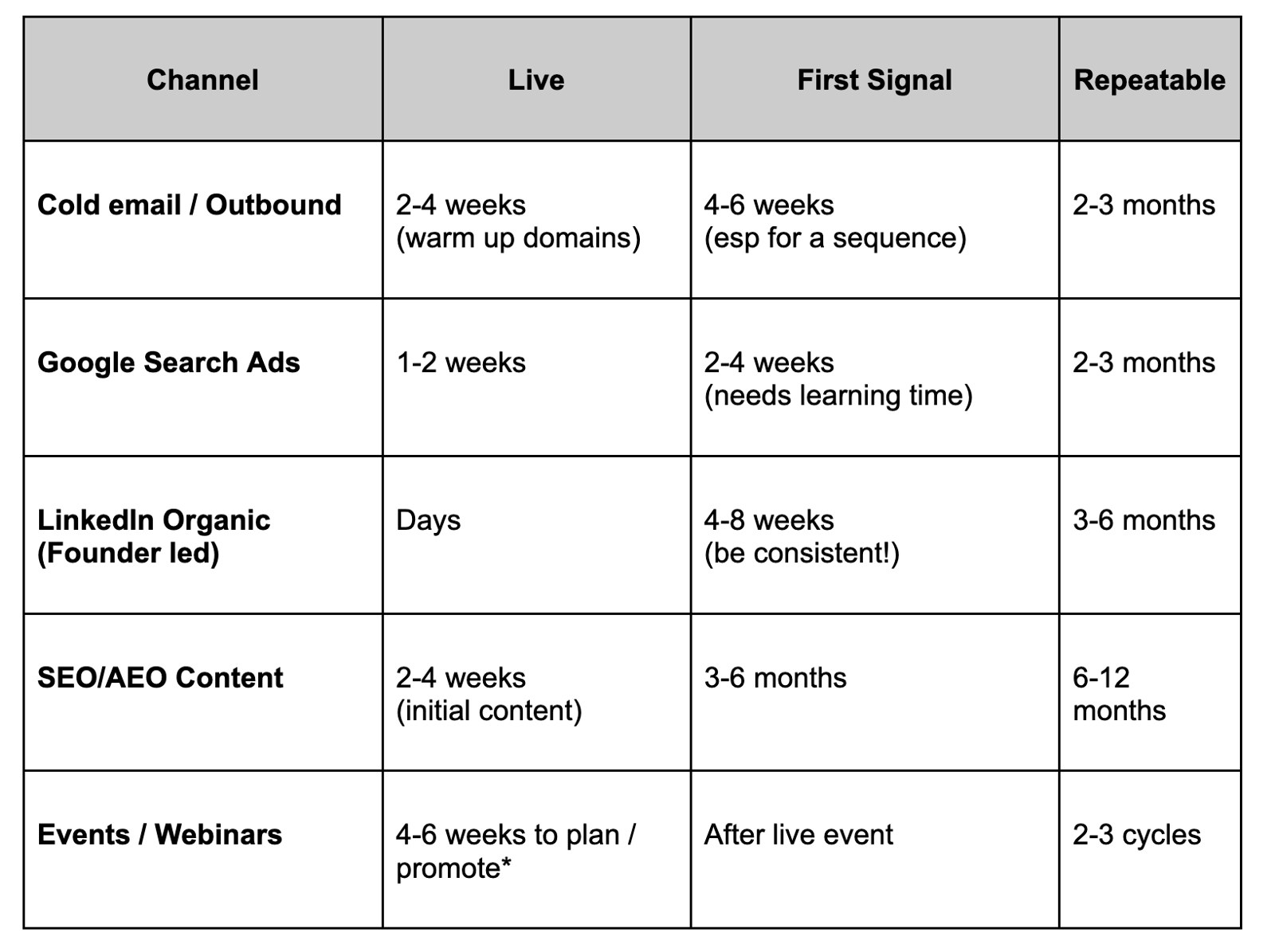
It takes 2–3 months to know if a channel is right for you. Launching isn’t the slow part. Collecting enough data to trust the result is.
There are roughly 25 possible channels for a B2B marketer across paid, organic and offline. Reddit? TikTok? Substack? Yikes. Here’s a realistic view of a few:
Days 1–30: Listen and lay the foundation
By now you should have had enough prospect calls to spot patterns. Aggregate the learning and pull content straight from it. As I always say: from their mouths to your pages. Don’t spin it, whitewash it or add your two cents. Keep it raw.
Then tailor it by channel. Visuals and landing pages are fast and easy now, but they still need opinion and taste.
Heads-up Founders: don’t be the bottleneck. I’ve watched too many cooks spoil the dish. Set expectations, then give your marketer free rein. Editing every asset signals control and distrust. Get out of the way and let the experiments run.
Days 31–60: Launch the experiments
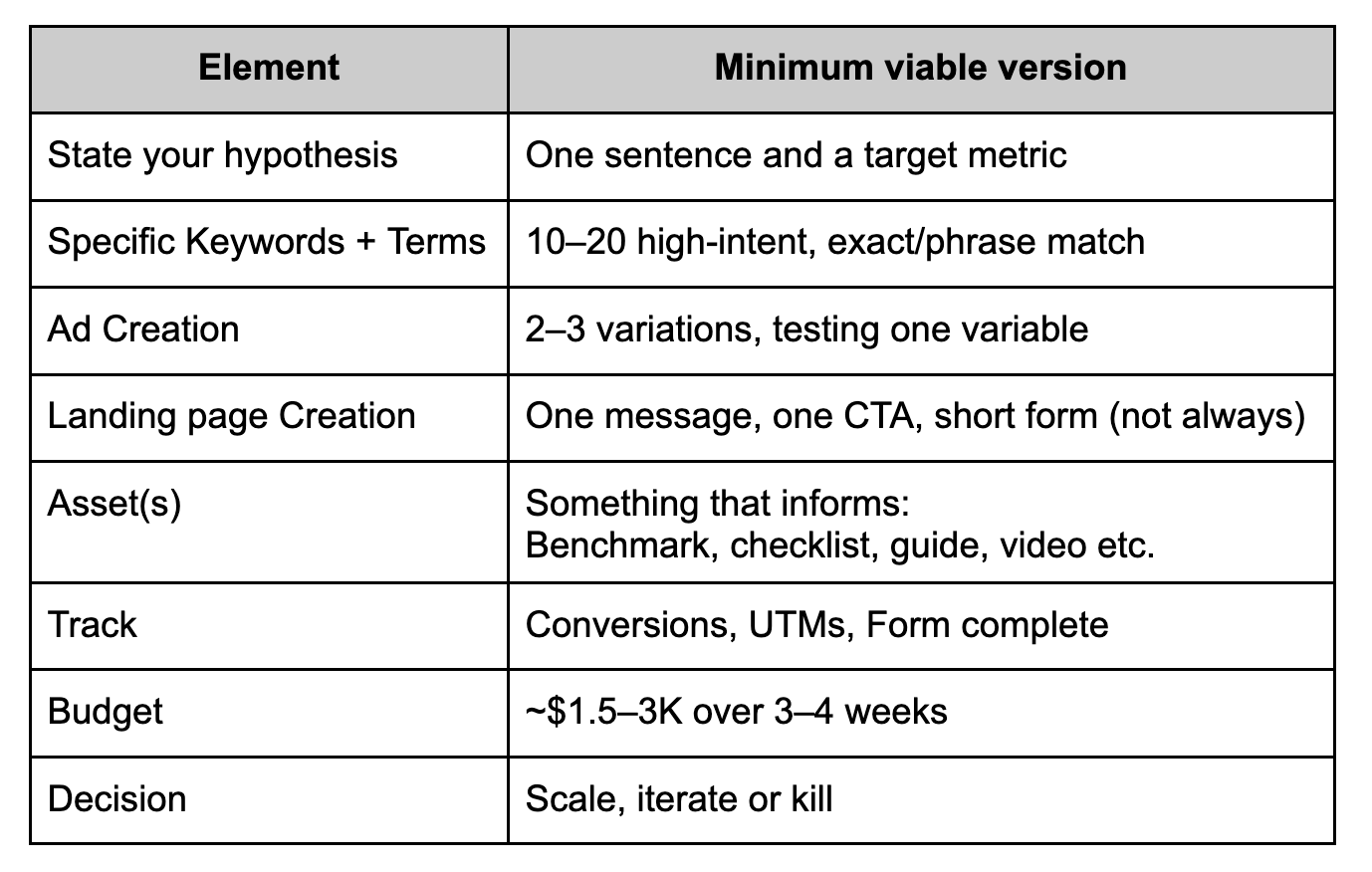
One coveted persona? Pick 2–3 channels where they actually spend time and place trust. Testing Google Ads? Here’s the minimum viable version:
Single-thread experiments are tough for sales-led, higher-ticket B2B. Always amplify paid with organic, and retarget once paid proves itself. Organic is table stakes. Start there and stay consistent.
AI will help you move faster, but don’t hand it the keys. The human with taste drives, then iterates.
Heads-up Founders: A channel that works today may die tomorrow. A former colleague called it day-trading: constantly moving money to wherever it performs.
Days 61–90: Double down and build the machine
By now you know what’s working. That’s the art and science of marketing: craft the message and offer, then see if the market bites. As Exit Five’s Dave Gerhardt points out, every company is different and there’s no tried-and-true playbook. Anyone promising one is selling you something.
When you get a bite, take that story everywhere. A blog post that lands becomes landing page copy for paid, then a how-to video series or podcast episodes. Buyers need to see you across channels. That’s how trust gets established.
Heads-up Founders: Share leading metrics early. Sales want hand-raisers, but those are a lagging indicator. Show landing page visits, traffic bumps and ad conversions first.
Months 4–6: Scale what works
Once a channel delivers, expand. Test an adjacent persona or message. Make bold claims about a new feature, a marquee customer or a win against your closest competitor.
Every new budget line, from an in-person event to a joint partner webinar, is another shot at trust. At Catch+Release, a content licensing marketplace for big brands, we ran Masterclass sessions showing how easily you could build ads from existing internet content instead of an expensive shoot or mediocre stock footage. Self-serve adoption tripled.
“Where are my leads?” How to answer
Every founder is impatient. It comes with the territory. Instead ask for: “What have we learned, what’s working, and when do we expect to see pipeline.”
Leading indicators: engagement, replies, followers, demo requests, sales calls
Lagging indicators: pipeline and revenue
Heads-up Founders: Remember enterprise deals take 7–12 touches. That doesn’t happen in three weeks. You didn’t hire a marketer to throw a few Hail Marys this month. You hired them to build the thing that finds leads every month.
Systems beat busywork
Activity isn’t progress. A marketer who posts daily and measures nothing is just making noise. Systems let a small team scale; experiments let it learn fast. Both matter more now that AI makes content dirt cheap.
AI can run the tests. Deciding what to test and what the results mean? That’s judgment.
A founding marketer won’t flood you with leads in 30 days, and if they do, I’d question the quality. In six months, they’ll hand you a working engine and the clarity to scale it.
If you hired a founding marketer , what would you want them to prove by day 90?
Thanks for reading! Subscribe for free to receive new posts and support my work.