

Marketing is about having a natural, organic conversation with your buyer. At a minimum, the conversation must be relevant and clear. Also, it must be concise and hopefully interesting and informative.
By communicating with your buyer (or potential), you want to get on the same page first and then motivate them to take action. Sometimes the action is to simply follow, like or listen to what you have to say. Ideally your prospect will at some point take the most coveted step — purchase — and come back for more.
The world is online, always
In our digital, competitive markets, message is everything. You can no longer rely on the charms or smarts of your sales team to woo an interested prospect. Physical meetings over lunch or a fun activity are practically non-existent. Communication forms have changed and expanded, even in the past few years. Thanks to tools like Slack, user communities are active and interactions are commonplace, with no vendor in the conversation.
On-demand webcasts, podcasts and twitch sessions give users the opportunity to listen and learn on their time. How users learn and adopt products has also changed. It’s pretty much in-app or via SMS support and customer success. Wifi access and a device is all a user needs.
Communication is real-time but it’s also on the user’s time which is of course “always-time”. Of course you want prospects to keep coming to you for content. Nurture is the name of the game and a continuous conversation because we know timing is everything.

Make it specific
Assuming your prospect hasn’t unsubscribed, there’s some interest in what you have to say. You need to work hard and make it specific to their role, function, interests and challenges. Deeply understanding their day-in-the-life is a good start. Learn what your buyer uses today or what mix of products they rely on because context is everything. The more you know about their problem-set, the more your message will resonate.
Surface level knowledge only gets your message so far. By digging in deeper you can passionately describe their pain, which of course you’re in a position to solve. In some cases, the conversation doesn’t have to even hint at the solution. You just need to convey that you get it, totally.
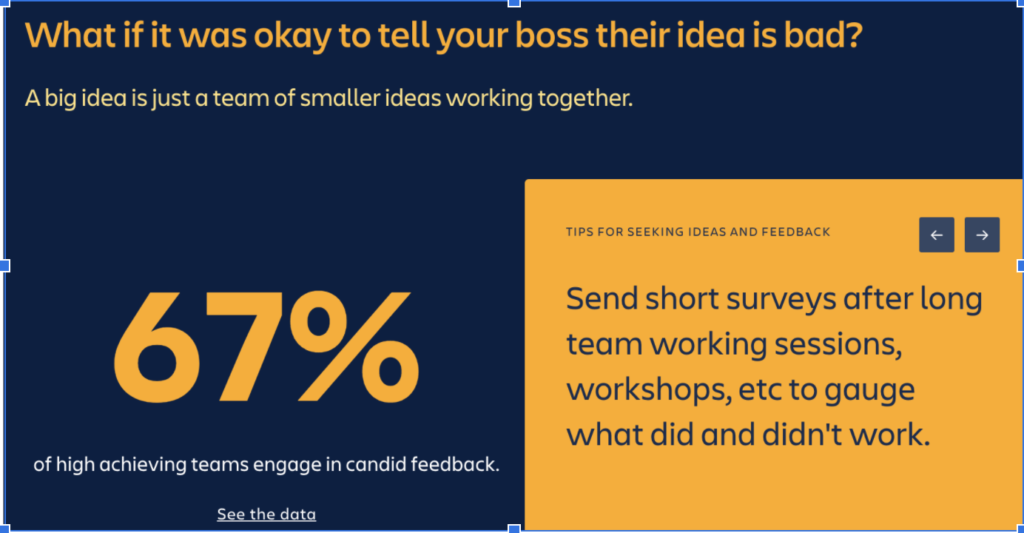
Here’s a nice example of a message that’s pretty specific. Remember Atlassian is a collaboration, project management tool for teams to share and update their work tasks.
So the heading is pretty intriguing. It provokes thought. The subhead (A big idea is just a team of smaller…) takes that same thought further and gets the reader to lean-in. Then, wham the % statistic gets you thinking even more about this bold statement. Now you want to see the data! Click.
The bright yellow CTA is promoting the survey feedback feature inside Atlassian’s offering. Most teams unfortunately start with the product feature they want to promote and then try to make it useful without coming off as overly self-serving. That approach often fails as most readers see right through the blatant promotion. It’s like having a conversation with someone that is a little too braggy.
Certainly there’s a time and place to be obvious but it’s more interesting to use a message that gets attention and gets a click. And, don’t forget that you’re offering the reader useful insights.
I found another example of specific messaging that really resonates with the user. Gong, serving teams who need to conduct business via Zoom or a digital meeting.

Gong’s technology is great at capturing call details and presenting insights and analysis on keywords, pricing mentions or the competition. Selling is all about listening, especially to the customer. This message shows that Gong really understands the job of sales and their #1 focus, everyday.
I believe they hit the nail on the head. It’s the outcome that matters. Not how Gong’s technology works to transcribe and compute audio streams. A sales person reading this will be intrigued and will likely want to hear more. Ultimately they need to swallow that reality. A thick-skinned sales person can handle this type of in-you-face message.
Timing is everything
If you outbound too often, recipients will become irritated. Of course someone can choose to ignore, or unsubscribe but it’s annoying and not good for the brand. When you have something interesting to share, then yes absolutely tell the market. Stick by the core rules and be clear, concise and relevant.
Ultimately your market will tell you how often they want to hear from you. The trick is to stay consistent rather than go quiet for weeks on end and then suddenly become noisy because you have something you want to say. Think of it like training your market about how often you communicate or when they should expect to hear from you. Keep the cadence predictably consistent and don’t over-do it. If you were having a conversation, it would feel like someone is shouting or talking too much.
Optimize for the right communication vehicle.
Some buyers prefer audio and some prefer video and depending on the asset, the written word may be best. In an ideal world, you’d love to ask each buyer their preferred media and also frequency. For proactive subscriptions, this is as simple as clicking a few options.
However, you also need to learn this through experimentation and response rate tracking by asset and by persona etc.
A/B Testing is always a good practice
Of course employ A/B testing to determine what works including day of the week and time of day. Start with a minimum viable set of assets using different mediums and then proactively ask for feedback. Experiments can be conducted in a matter of weeks but they still take effort and resources. Cut to the chase and ask your market directly which then helps you understand them more deeply. If you have an online community, a quick poll will guide you on what’s best.
Clarity of message reigns supreme and it does take cycles to build the foundation and core keywords. Take the time to distill it and I guarantee you that it will pay dividends down the road after several internal and external iterations.
Stay the course
Like aging whiskey, your core message should not change even over many quarters and years. Unless of course your business, product or target buyer changes. Then regroup and re-clarify.