

Gartner recently hosted a 2025 predictions webinar in late January and it's always worth a listen as they tend to look farther out than one year, taking a macro-landscape view, which is one I like to keep an eye on. While Gartner needs to consider B2B, B2C and all org sizes, buying behavior patterns remain fundamentally the same and B2B buying is a lot closer to consumer behavior now than ever before. People demand authenticity, valuable information and they tend to be 'hands-off' until the timing is right. You still have to earn their trust.
Ultimately, this places more pressure on marketers. You still have to pay very close attention to buyers - from their interests, where they hang out and the behaviors they display before they lean in to a buying cycle.
Thanks for reading! Subscribe for free to receive new posts and support my work.
Two Gartner predictions stood out as important over the coming year:
AI-powered search requires major content changes.
Subscription based content platforms are on the rise. 30% of paid social will support ads on these channels by 2028.
Let's dive into the prediction 1. AI-powered search and how it's changing the way our content is developed.
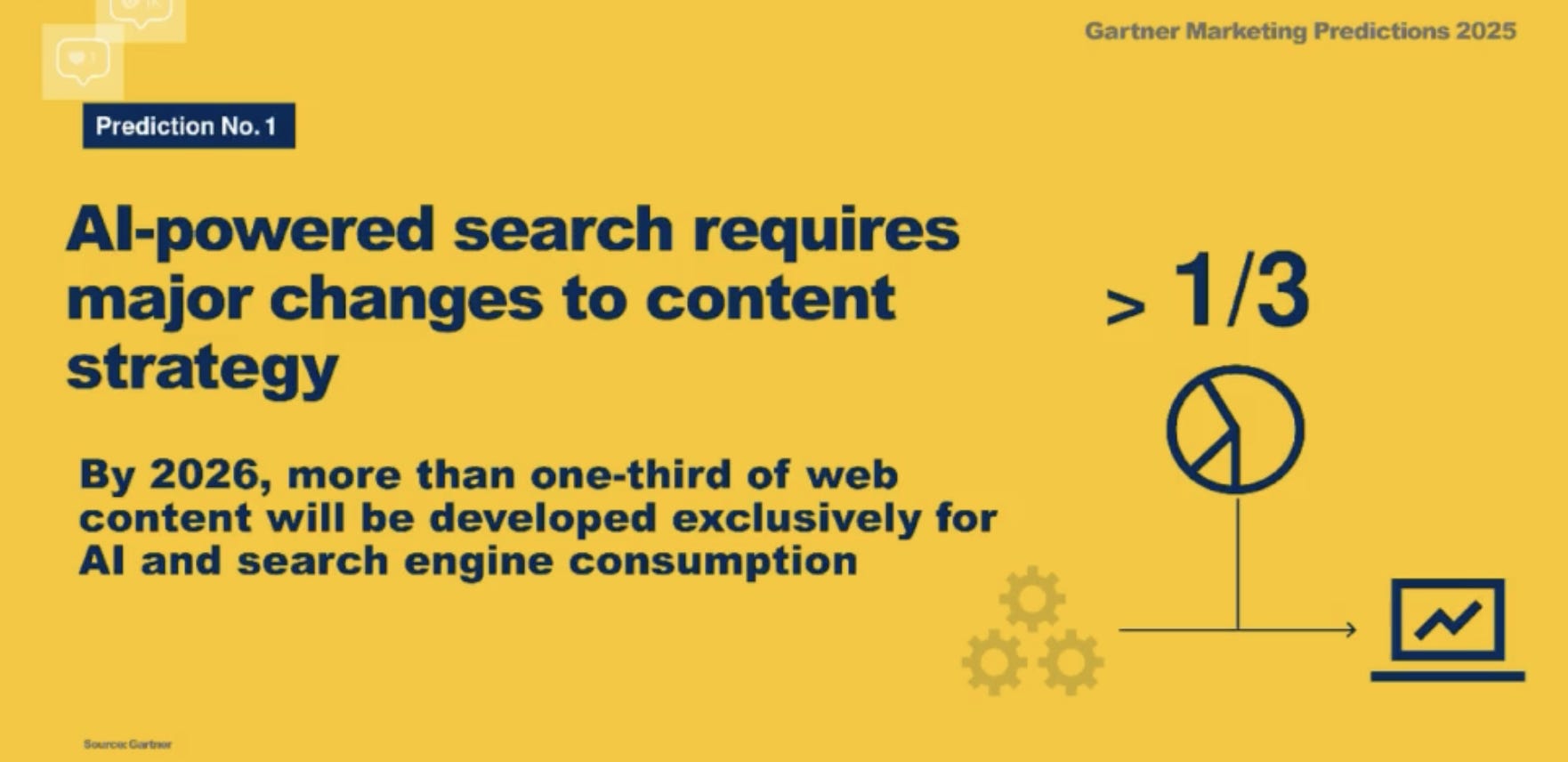
Teams need to pay more attention to what buyers seek and respond to, and also where to place content. Also, teams now need a strong understanding of how AI influences search algorithms. This doesn't mean you abandon organic search or throw out the existing playbook. It will however need to be augmented.
Search referral traffic remains a crucial factor for brands, although there is a noted decline in search visibility due to algorithmic changes. Organic search is expected to remain pretty flat as it did in 2024, prompting continued investments in paid search and changing SEO strategies.
Plan More Broadly, Beyond Only Keyword Optimization:
Besides optimizing landing pages for keywords, you also need to consider other factors which Google calls Topic Clusters (introduced mid 2023), and this needs a broader, thematic approach and also consider the types of search terms a prospect uses, depending on their stage of the journey. That will then determine your content plan and what you create by funnel stage. IOW, your classic top, middle, and bottom. Only you can plan out what terms and topics are searched for by stage, which is unique to each business.
The challenge is often that SEO teams take a narrow view when optimizing for search. They tend to look at tools like AHrefs or SEMrush and the competition or landscape of players in their market. This is important but not complete.
Other ways to garner a more complete view:
Conduct consistent social listening to capture what's being discussed on your top, most relevant social channels.
Transcribe recordings from your top customer calls or prospects in active buying cycles. From their mouths to your ears.
Proactively ask prospects how they found you and what their thought process was. Always hard especially if you have a PLG-led model.
Employ the right set of attribution tracking and not only original source or most recent lead source detail, from HubSpot.
In this SEO article by expert Adam Tanguay, you'll see a nice hub-spoke diagram to help create those themes and topic clusters. Each cluster will have X # of top keywords. The best way to build those is to pay attention to what's being discussed and sought after in your relevant market.
Adam further dives into what brands can do to expand search results especially as LLMs evolve to becoming a default for business users. This article discusses how many of us enjoy the aggregation of information from their prompts and questions in LLMs such as ChatGPT and Perplexity, which continue to improve weekly.
High Quality Content and Yes, Lots of It Wins the Day
However, the reality is teams need to still focus on producing high quality content to increase the probability and results of it surfacing in the right channels where buyers hang out and more importantly, to also surface in LLM results.
Those specialized channels may be Reddit or discord or say a dev.to for engineers, for example. With so many content channels, take the time to conduct research and audits up front and know exactly where to focus. Teams in the B2B space should not only rely on LinkedIn or what many consider a "mainstream" social channel that covers a very broad range of conversations and content. Ultimately, it's a breadth vs depth question and you need to do both. A little harder for small teams and younger companies that don't have an established brand yet.
Prediction #2: Subscription-Based Content Platforms On the Rise
The 2nd prediction is about where to place content, which will not only vary by topic and type but also by relevancy for a particular channel.
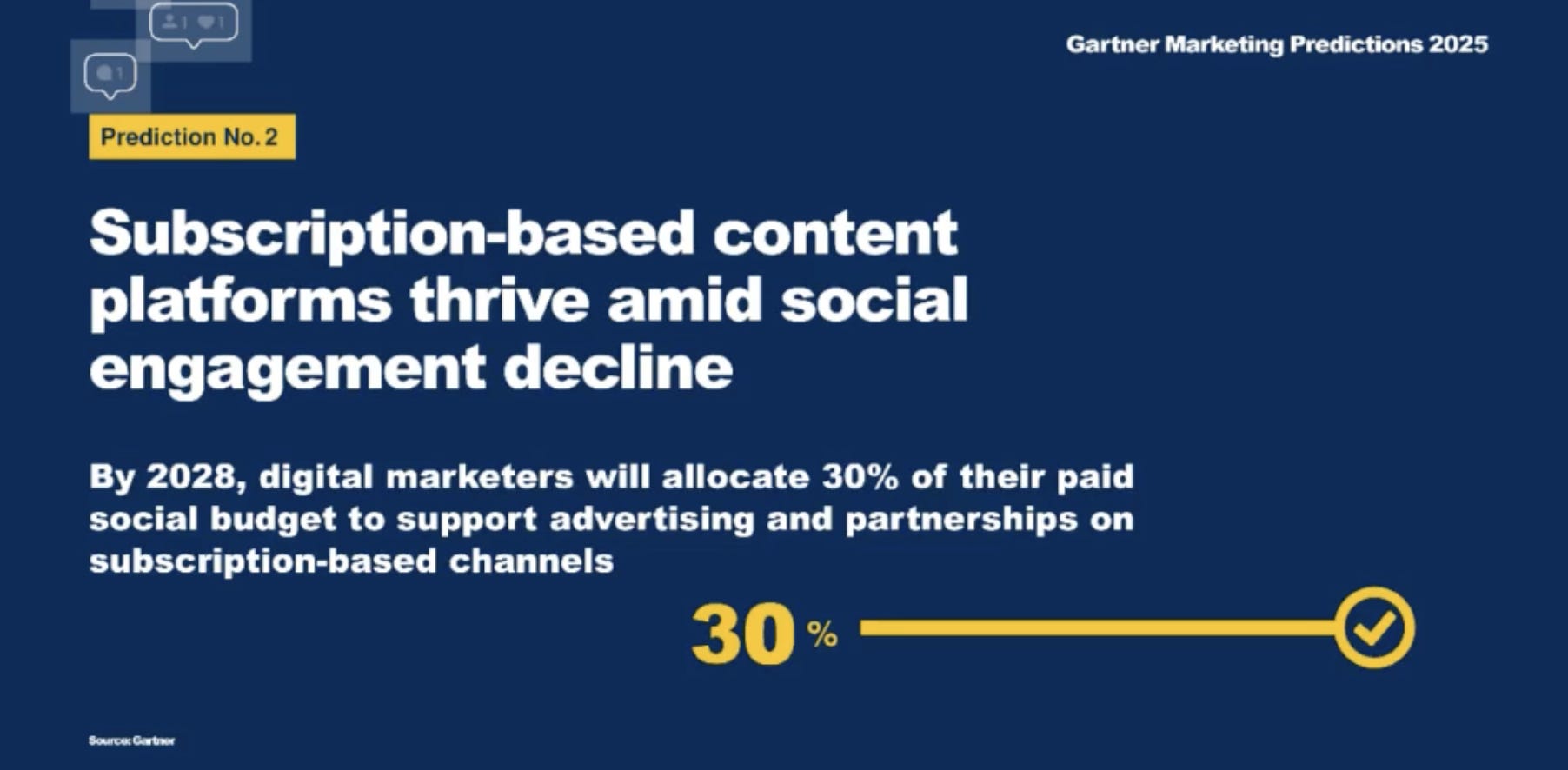
CMOs and teams will put more budget dollars behind paid ads in these types of channels, according to Gartner. They predict that it will increase by 30% in 2028. That's probably a safe bet, but I'm curious to watch this as the year progresses.
One of the key insights shared was that brands are expected to allocate a larger percentage of their budgets to paid subscription content channels, while reducing their spending on social media channels. Platforms like Substack are gaining popularity as they offer a trusted alternative to influencer-driven content, which can sometimes lack credibility.
Where Do Your Customers Hang out and Consume Content?
The webinar emphasized the importance of researching and exploring the current trends on these platforms, as they are already rich with user-generated content that is perceived as authentic, trusted, and recommended by peers.
Platforms like Substack and Discord are noteworthy in this context. Substack, for instance, boasts 35 million users, with 3 million of them being paying subscribers. This platform is experiencing rapid growth, attracting an engaged audience that is more receptive to the content offered.
Over 2024, engagement levels across the largest social platforms have remained relatively flat. While this trend appears to be more consumer-oriented, it's not surprising that many business users are starting to turn off the amount of time they engage on social platforms as their time increases in using LLMs and AI-type platforms.
Many users cite misinformation and a lack of quality content as primary concerns. Furthermore, 70% of users believe that the adoption of generative AI content, especially for consumer brands is negatively impacting content quality, which may be contributing to this decline.
Overall, the landscape of subscription-based content platforms is evolving, with both challenges and opportunities for content creators and advertisers alike.
The Good News! How AI Can Fast-track Quality Content Creation
There are a slew of new products entering the market for GTM teams. AI apps and platforms that fast-foward the creation of valuable, quality content that is highly targeted and personalized.
One such AI Agentic startup is MarkovML and their pre-built apps will do:
- Generate SEO blog from a YouTube video
- Generate Social Posts from a YouTube video
- Learn sentiments and trends from a competitors website
- Transcribe a sales call and review for sentiment and trends.
You get the idea. Previously manual tasks no more. Use AI to do the legwork for you and not only in a fraction of the time but reliably and safe.
If you want to see any of this in action, shoot me an email: deirdrebmahon@gmail.com
Thanks for reading! Subscribe for free to receive new posts and support my work.